Exchange Transparency SWOT-Analysis: Consider It Before You Deposit
ExchangesBit News Today3 min read
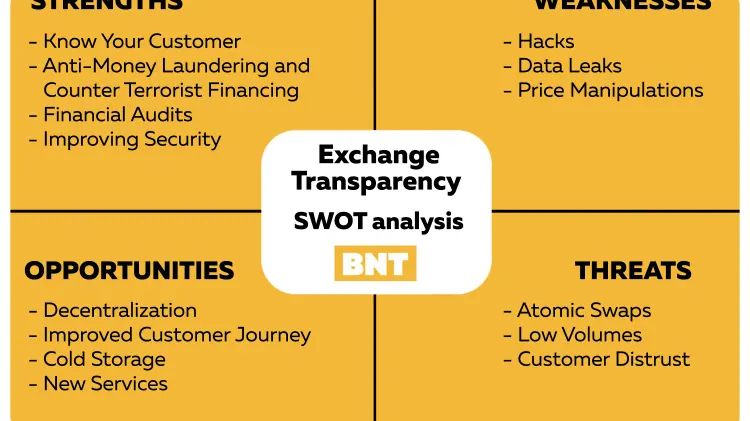
SEC staff members have expressed concern that many online trading platforms give investors the impression of being registered and regulated marketplaces when they are not. The agency notes that many crypto exchanges give the impression of being SEC-registered and regulated marketplaces, when in fact they operate without this designation. As a result, the trading protocols these platforms use remain outside the SEC's purview. These protocols regulate how orders interact and execute, and the access to trading services may not be uniform across all users. Consequently, investors should not assume that the trading practices adhere to the standards of an SEC-registered national securities exchange. National securities exchanges registered with the SEC are required to enforce rules aimed at preventing fraudulent and manipulative actions.
Heading: Exchange Transparency SWOT-Analysis: Consider It Before You Deposit
The FDIC, which insures bank deposits in the U.S., does not cover digital assets held by crypto platforms, though dollar deposits stored at FDIC-member banks may qualify. Additionally, SIPC protection—which shields brokerage clients from loss of cash or securities in certain conditions—does not cover crypto asset losses. The SEC acknowledges that none among the major crypto asset entities is registered as a broker-dealer, exchange, or investment adviser under the SEC's purview, thus not extending the associated investor protections. Centralised exchanges do not receive the government oversight that banks do and have no legal obligation to provide proof of solvency.
While cases of speculative crypto trading and exchange site hacks increase, the scope of personal information protection undertaken by top crypto exchanges remains very weak, as warned by the chairman of South Korea's communications commission. Coincheck, an exchange based in Japan, disclosed a hack that pilfered around $533 million worth of XEM in what appeared to be the largest single theft in crypto history. Gox lost 750,000 user-owned bitcoins following a cyberattack in 2014. Investor faith in crypto platforms hit rock bottom in 2022, with Celsius, BlockFi, and Voyager among companies turning bankrupt. Famously, FTX secretly lent over $8 billion from user funds to its sister trading firm Alameda Research, before that firm's quick bankruptcy set off a chain reaction that ultimately brought FTX and 9 million user accounts down.
Proof of Reserves (PoR) declarations from centralised exchanges help users verify the institution's asset holdings, without exposing user identities. Most platforms cryptographically publish their reports through a data structure known as a Merkle tree. However, the reliability of a Merkle tree depends entirely on the accuracy of the data within it. Of the more than 50 exchanges on the dashboard, only three have supplied audit information. PoR status is effectively a snapshot, only validating reserve holdings at a specific point in time. It generally does not confirm whether those reserves are encumbered.
Experienced users recommend cold storage as the go-to strategy, only keeping on exchanges assets actively traded; those exchanging any assets should look for platforms with 2FA options beyond SMS authentication. As shown by events at FTX and Celsius, centralised exchanges can lend or trade away user assets without their knowledge until withdrawals reveal a shortfall of available crypto. To sidestep this risk, investors can keep crypto in non-custodial wallets, removing the risk of misappropriation. DEXs also solve this problem -- since these decentralised peers do not custody users' funds, they cannot be a party to trading away an investor's cryptocurrency. However, in trading fiat currency for crypto, a centralised custodial service remains necessary.